
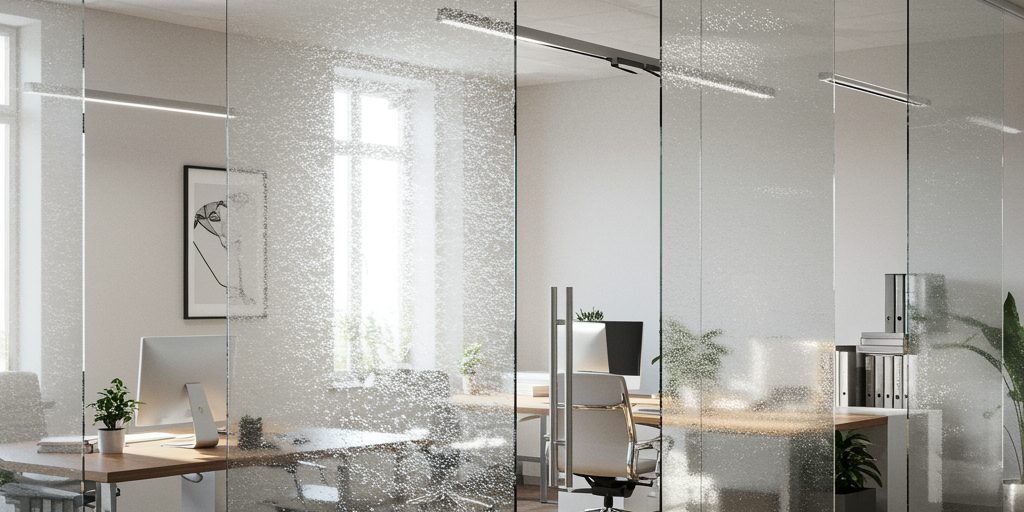
Modern buildings depend on natural light. Large windows, glass walls, and storefront systems allow daylight to enter interior spaces, making buildings feel open and inviting. At the same time, many commercial environments still require privacy.
Offices, meeting rooms, bathrooms, healthcare facilities, and storefront entryways often need privacy without blocking natural light. This is where patterned glass becomes a practical solution.
Patterned glass—sometimes called textured or decorative glass—allows light to pass through while obscuring direct visibility. The result is a balance between brightness and privacy that works well in both commercial and architectural designs.
For glazing contractors, window manufacturers, and building designers, patterned glass provides a flexible material that solves two common design challenges at once.
What Is Patterned Glass?
Patterned glass is a type of decorative glass that features a textured surface created during manufacturing. The pattern distorts the view through the glass while still allowing light to pass through.
Unlike frosted glass, which often uses chemical or sandblasted treatments, patterned glass is formed with a design pressed into the glass during production.
This creates a permanent texture that provides visual privacy while maintaining strong light transmission.
Patterned glass is commonly used in:
- Commercial office partitions
- Bathroom windows and shower enclosures
- Storefront accent panels
- Entry doors and sidelights
- Interior glass walls
- Decorative architectural features
Because the patterns vary widely, designers can choose options that provide subtle privacy or stronger visual distortion.
Why Natural Light Matters in Building Design
Natural light plays an important role in modern architecture and commercial building design.
Buildings that maximize daylight often feel more open, comfortable, and welcoming. In office environments, natural light can also improve employee comfort and productivity.
For retail storefronts, natural lighting helps showcase merchandise and create inviting spaces for customers.
However, fully transparent glass does not always provide enough privacy. In certain spaces, occupants may feel exposed or distracted by outside visibility.
Patterned glass solves this issue by maintaining light flow while reducing direct visibility.
How Patterned Glass Creates Privacy
The texture on patterned glass bends and diffuses light as it passes through the glass. This distortion prevents clear visibility through the glass while still allowing brightness to enter the room.
Different patterns offer different levels of privacy.
Some patterns provide mild distortion, allowing shadows and outlines to remain visible. Other patterns offer stronger privacy by breaking up the image more dramatically.
Common levels of patterned glass privacy include:
Light distortion patterns – Allow soft visibility while reducing sharp detail
Moderate distortion patterns – Provide stronger privacy while maintaining brightness
Heavy texture patterns – Greatly obscure shapes and movement for maximum privacy
Because of these options, patterned glass can be selected based on the specific needs of each space.
Patterned Glass Still Allows Strong Light Transmission
One of the biggest advantages of patterned glass is that it allows natural light to pass through.
Unlike solid partitions or tinted materials that darken a space, patterned glass keeps interiors bright while maintaining privacy.
This makes it especially useful in spaces where daylight is important but full transparency is not desirable.
Examples include:
- Conference rooms facing public areas
- Office partitions between departments
- Healthcare environments
- Restaurant or hospitality interiors
- Commercial bathroom windows
By maintaining strong light transmission, patterned glass helps reduce the need for artificial lighting during the day.
Patterned Glass Adds Architectural Character
Beyond privacy and lighting, patterned glass also contributes to the visual design of a building.
Architects often use textured glass to add depth and character to interior or exterior spaces. The patterns create visual interest while still maintaining the clean look associated with modern glass architecture.
Some designs feature subtle textures that look almost smooth from a distance. Others include bold geometric patterns that become a decorative feature within the building.
Popular patterned glass designs include:
- Reeded or fluted textures
- Frost-like patterns
- Linear patterns
- Geometric shapes
- Organic or wave patterns
These designs can complement both modern and traditional architectural styles.
Patterned Glass Works Well with Modern Storefront Systems
Patterned glass is also commonly used alongside aluminum storefront systems in commercial construction.
Storefront entrances often include glass doors, sidelights, and large panels that provide visibility into the building. In certain cases, patterned glass can add privacy without completely closing off the space.
Common storefront applications include:
- Entry door glass
- Side panels beside entrance doors
- Decorative interior glass walls
- Privacy panels for office lobbies
Because patterned glass is available in tempered, laminated, and insulated glass configurations, it can be integrated into many types of commercial storefront systems.
This flexibility makes it useful for both interior and exterior applications.
Safety and Strength Options for Patterned Glass
Patterned glass can also be manufactured with additional safety features when required by building codes.
Depending on the project, patterned glass may be produced as:
- Tempered safety glass
- Laminated safety glass
- Insulated glass units (IG units)
- Low-E coated glass combinations
Tempered patterned glass increases strength and helps prevent dangerous breakage. Laminated patterned glass adds an additional safety layer that holds the glass together if it breaks.
These options allow patterned glass to meet safety requirements for commercial buildings, storefronts, and high-traffic areas.
Patterned Glass for Interior Design and Commercial Spaces
Many modern commercial interiors use glass partitions instead of solid walls to create open, collaborative environments.
However, complete transparency can sometimes create distractions or reduce privacy.
Patterned glass allows designers to maintain an open environment while adding visual separation between spaces.
This approach works well in environments such as:
- Corporate offices
- Healthcare facilities
- Retail environments
- Hotels and hospitality spaces
- Restaurants and entertainment venues
By diffusing light while reducing visibility, patterned glass helps create comfortable, well-lit environments without sacrificing privacy.
Choosing the Right Patterned Glass for a Project
When selecting patterned glass, contractors and designers typically consider several factors.
These include:
- Level of desired privacy
- Amount of light transmission needed
- Safety glass requirements
- Compatibility with framing systems
- Overall architectural design
Each project may require a different level of privacy or visual appearance. Working with experienced glass suppliers helps ensure the selected product meets both performance and design requirements.
Reliable Glass Supply Matters for Contractors
Glazing contractors, window fabricators, and builders often work under tight timelines. Reliable material availability plays an important role in keeping construction projects on schedule.
Choosing high-quality glass products helps ensure that installations meet performance expectations while reducing delays and replacements.
For contractors working throughout Texas, Oklahoma, Louisiana, New Mexico, Arkansas, Missouri, and Kansas, dependable access to glass products is an important part of project success.
Conclusion
Patterned glass offers a simple and effective solution for balancing privacy and natural light in modern buildings. By diffusing visibility while maintaining brightness, patterned glass supports comfortable and visually appealing interior spaces.
Its flexibility, decorative appeal, and compatibility with storefront systems make it a valuable material for commercial construction and architectural design.
Sky Building Materials supplies a wide range of glass products, including patterned glass, insulated glass units, laminated glass, and aluminum storefront materials for glazing contractors and fabricators across the region.
With locations in Dallas at 10835 Shady Trail, Dallas, Texas 75220, Houston at 4600 S Pinemont Drive, Houston, TX 77041, and a new location in Tulsa, Oklahoma, Sky Building Materials helps professionals source reliable materials for commercial building projects.
To learn more about available glass products and storefront systems, visit the Sky Building Materials Contact Page:
https://skybuildingmaterials.com/contact/
You can also stay connected with industry updates and product highlights on the Sky Building Materials Facebook Page.